
Shaders
A view can fill a box with a shader of its own: a function from a point of the box to a color, run for every pixel. You write it once, in ZSL, a small language in Zig's syntax, and ui.shader.compile compiles it at compile time into HLSL (Direct3D 11), GLSL (OpenGL 3.3, OpenGL ES 3.0 and WebGL 2), Metal, and a CPU twin of Zig code that draws the same pixels, within rounding, where no GPU draws: the CPU renderer and ui.Tester. So a shader works on every platform and in tests, and a mistake in it is a compile error of the app.
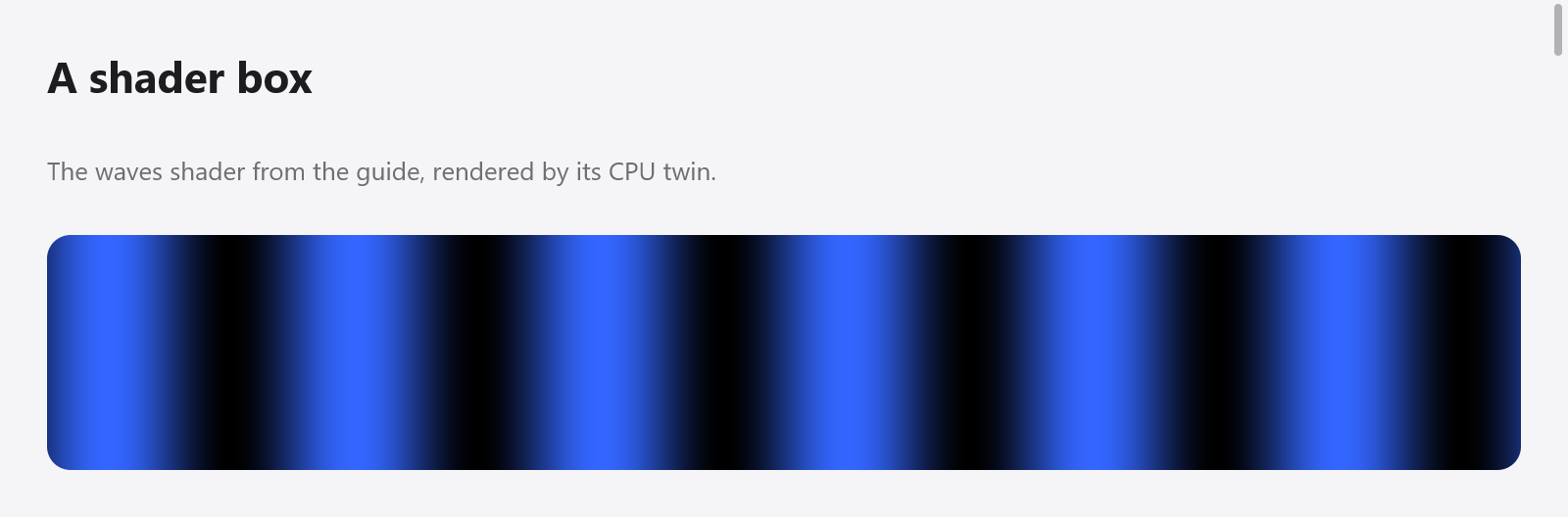
The waves shader from this guide, rendered by myzig's CPU twin.
const waves = ui.shader.compile("waves",
    \\uniform time: f32;
    \\pub fn fragment(pos: vec2) vec4 {
    \\    const v = 0.5 + 0.5 * sin(pos.x / 20 + time);
    \\    return vec4(v * 0.2, v * 0.4, v, 1);
    \\}
);

fn view(_: *State, c: *ui.Context) void {
    _ = ui.shaderBox(c, &waves, .{}, .{ .width = .fill, .height = .{ .px = 120 }, .radius = 12 });
    c.end();
}
Longer shaders live in files of their own, .zsl, embedded:
pub const shader = ui.shader.compile("wind", @embedFile("wind.zsl"));The examples are made of shaders: blackhole (light traced through gravity, a drag orbits the camera), wind (a texture of characters stirred by the wind), chat-glow (an orb, a ring, an edge glow and a shimmer, sharing a palette), effort-slider, mayoi, and the gallery. Run them with zig build run-blackhole and so on.
Shader boxes
ui.shaderBox(c, &shader, values, style) opens a box styled by style, filled by the shader; its children follow until c.end(). The shader replaces the box's background, and is clipped to its rounded corners. values is a struct whose fields set the shader's uniforms (below). ui.shaderBoxWith(c, &shader, values, style, options) takes ui.ShaderBoxOptions, whose blur blurs what is under the box before the shader reads it with backdrop(p).
ui.shaderEffect(c, &shader, values, last_rect, options) makes the shader an effect for any box's Style.effect, allocated for this frame: a box drawn from what is under it, as frosted glass is (Transforms and effects). last_rect is the box's rect in the last layout, for the pointer uniform.
const id = c.peekId("lens");
const fx = ui.shaderEffect(c, &lens, .{ .strength = 0.4 }, c.rects.get(id), .{ .blur = 2 });
_ = c.open(.{ .width = .{ .px = 200 }, .height = .{ .px = 120 }, .radius = 16, .effect = fx }, "lens");
c.end();
The fragment function
pub fn fragment(pos: vec2) vec4 { ... }pos is the point in the box, in points from its top left corner. The function returns the pixel's color, premultiplied (vec4(r * a, g * a, b * a, a)), drawn over what is under the box: alpha 0 leaves it as it is.
Uniforms
uniform name: type; at the top declares a value the view gives each frame:
const root = ui.shaderBox(c, &shader, .{
    .seed = w.seed,                               // u32
    .time = t,                                    // f32
    .heading = [2]f32{ @cos(w.heading), @sin(w.heading) }, // vec2
    .tap = s.tap,                                 // vec3, as [3]f32
}, .{ .width = .fill, .height = .fill });
defer c.end();
Fields are numbers for f32, i32 and u32, bools, and arrays or vectors of floats for vectors; a ui.Color sets a vec3 or vec4, a ui.Point a vec2. A field naming no uniform is a compile error; a uniform left out is zero, with two exceptions:
time, anf32left out, is the context's clock (c.time), and the box then draws every frame. Givetimeyourself to freeze it (as tests do) or to start it at zero.pointer, avec2left out, is where the pointer is, in the box's points. Setc.wants_moves = truefor frames as the pointer moves.
Uniforms share the effect's sixteen floats: fifteen are theirs (a vec3 takes three), and the last holds the pixels in a point. ui.shader.params(&shader, values, scale) packs values into an effect's parameters, for an ui.Effect built by hand.
The language
ZSL is Zig's syntax for what a shader needs:
- At the top:
uniform name: type;,const name = value;, and functions (fn name(a: f32, b: vec2) f32 { ... }, at most eight parameters), withpub fn fragmentamong them. Functions may call each other in any order, but not themselves: shaders don't recurse. - Types:
bool,i32,u32,f32,vec2,vec3,vec4. - Statements:
constandvarlocals, assignments (=,+=and the others, components asv.xy = ...),if/else,while (c) : (i += 1),for (0..n) |i|,break,continue,return. - Numbers without a type take the one their use needs, as Zig's. Conversions are
f32(x),i32(x),u32(x). - Vectors are made as
vec3(v.xy, 1)orvec3(0); a float scalar mixes with vectors (v * 0.5);.xyzwand.rgbaswizzle. - Integers wrap;
<<,>>,&,|,^,~and%are theirs, andmod()the floats'. Hashes ofu32s (PCG and the like) work the same on every backend. - Comments are
//.
Builtins: GLSL's sin, cos, tan, asin, acos, atan, atan2, sinh, cosh, tanh, exp, exp2, log, log2, pow, sqrt, inversesqrt, abs, sign, floor, ceil, fract, round, trunc, mod, min, max, clamp, mix, step, smoothstep, length, distance, dot, cross, normalize, reflect; and myzig's:
| builtin | is |
|---|---|
size() | the box's size, in points |
pixel_scale() | the pixels in a point |
pixel() | the pixel's center, in the window's pixels |
backdrop(p) | what is drawn under the box at its point p, blurred by the box's blur, premultiplied |
A short example of most of it, from the wind example's start:
uniform seed: u32;
uniform time: f32;
uniform pointer: vec2;

const cell_w = 9.0;
const tau = 6.2831853;

fn pcg(v: u32) u32 {
    const s = v * 747796405 + 2891336453;
    const w = ((s >> ((s >> 28) + 4)) ^ s) * 277803737;
    return (w >> 22) ^ w;
}

pub fn fragment(pos: vec2) vec4 {
    const cell = floor(pos / vec2(cell_w, 18));
    const h = f32(pcg(u32(cell.x) * 7919 + u32(cell.y) + seed) & 1023) / 1023;
    const glow = 1 - smoothstep(0, 120, distance(pos, pointer));
    const v = 0.5 + 0.5 * sin(h * tau + time);
    return vec4(vec3(v * 0.3 + glow * 0.5), 1);
}
Prefixes are a way to share code: chat-glow compiles each of its shaders from palette ++ @embedFile("orb.zsl"), a file of functions they all use.
Errors
Errors are compile errors of the app, with the shader's name, line and column:
shader 'waves':3:24: mismatched types i32 and f32Types are checked as Zig checks them (no implicit conversions between i32, u32 and f32, beyond untyped numbers), names must be declared, a shader too long for its tables is an error (shader 'x' is too long), and so is recursion. ui.shader.checkSource(&program, src, msg) compiles at run time, for tests of the compiler.
How it is drawn
A shader box is a backdrop effect (Transforms and effects): paint marks it in paint order, and each renderer, at the mark, reads what it has drawn so far around the box (blurred if asked), and draws the box with the shader before drawing on. Direct3D, OpenGL, WebGL and Metal compile the generated source once per shader, the first time they draw it; the CPU renderer runs the twin, a function generated from the same program at compile time. The generated sources are in shader.effect (hlsl, glsl, msl) and the uniforms' layout in shader.uniforms.
A shader box whose time is left to the clock asks for every frame, so it keeps the app drawing while it is shown; one without it is drawn with the frames the rest of the view asks for, as any box is.
Testing shaders
The CPU twin draws in the Tester, so a test renders the view and looks at its pixels; freeze time by giving it:
var s: Pane = .{ .frozen = 4 }; // its view passes .time = s.frozen
var t: ui.Tester = undefined;
try t.init(gpa, .init(&s, Pane.view), .{ .width = 240, .height = 160, .scale = 1 });
defer t.deinit();
t.settle(1);
const px = try t.render(gpa);
defer px.deinit(gpa);
// px.bytes: BGRA, px.width × px.height
The examples' views are tested this way (zig build test runs the tests in examples/blackhole, wind, chat-glow, effort-slider and mayoi). src/ui/shader/tests_gpu.zig draws shaders that use every part of the language with Direct3D 11 (on Windows) and OpenGL (through EGL, on Linux) and checks that they match the CPU twin within a level or two; ui.gpu_testing offers the same comparison to plugins' tests.