
myzig architecture
This guide describes how myzig is put together: its layers, how it picks a platform, its threading model, how it calls native code without C, and the rules every file follows. Read it before changing code. Three companion pages go deeper:
- IPC and TypeScript generation: the wire protocol between a page's runtime (
src/bridge.js) and Zig, the outbox, channels, the app's schemes, and the client generated from Zig types. - Rendering: native UI's pipeline (context, layout, paint, frame), the renderers (Metal, Direct3D 11, OpenGL, WebGL 2 and the CPU), the CPU twin that proves them, text, atlases and each platform's surface.
- Testing, binary size and adding a feature:
ui.Tester, the--myzig-*flags, the build's test steps, the Linux container and the Wine images, the hill climb, and the checklist for a new feature.
Architecture at a glance
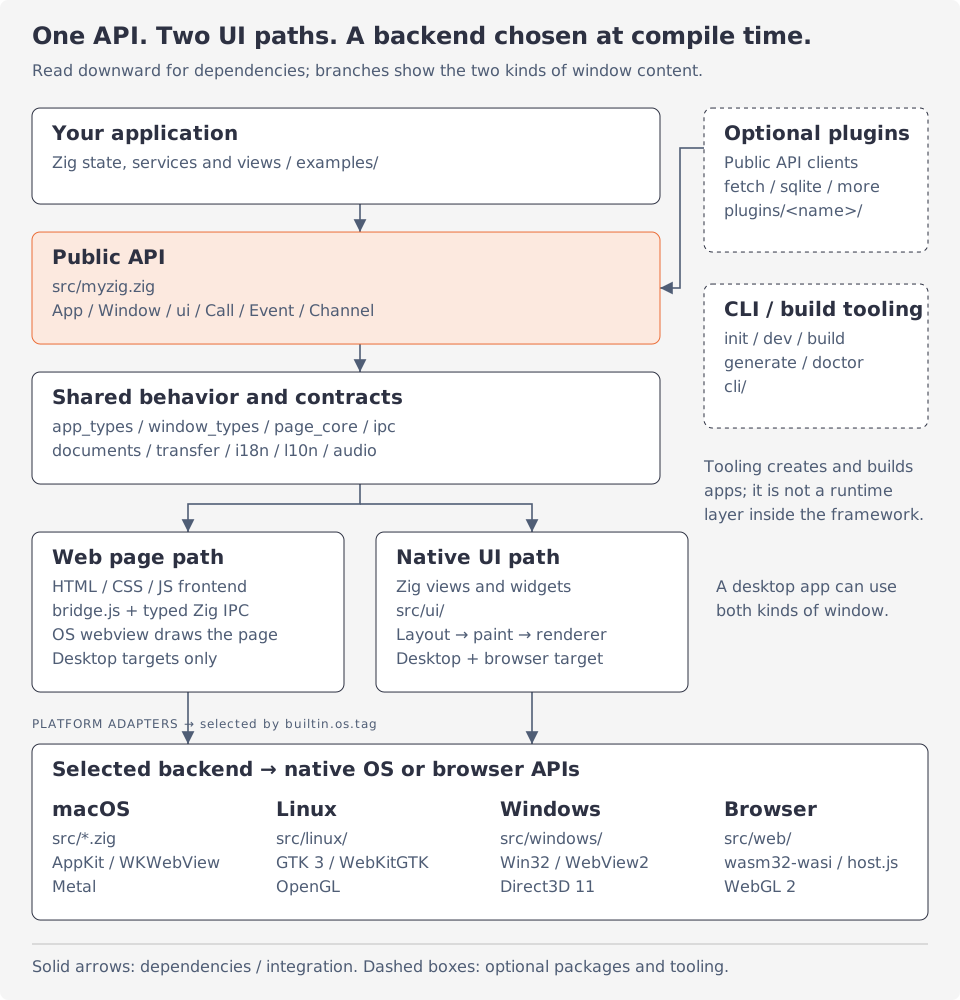
Start at the top: your app calls src/myzig.zig, which exposes shared contracts and the backend selected at compile time. Below the shared code, follow the window's content: a web page uses typed IPC and the system webview; a native view uses myzig's own layout and renderer. These are cooperating components, not a chain every API call traverses: desktop services such as menus and dialogs go directly to their platform adapters. Plugins consume the public API; the CLI creates and builds apps.
The browser target runs native UI through src/web/host.js and WebGL 2. The desktop webview IPC path is not a browser backend feature. A desktop app can have both page windows and native UI windows, and native UI can also embed a webview with the web view widget.
For the details, follow a page calling Zig or a native view becoming pixels. The standalone diagram sheet contains all three diagrams in one HTML file that can be opened offline.
Goals and constraints
- One Zig program per app. An app is a single binary (about 0.7 MB for the counter in
ReleaseSmall) with no runtime to install beyond what the system has: AppKit and WebKit on macOS, GTK 3 (and WebKitGTK for pages) on Linux, Win32 (and the WebView2 Runtime for pages) on Windows, a browser for the web target. - No C. No
@cImport, no.cor.mfiles, no shims. Native code is declared in Zig (extern) or loaded at run time (dlopen/dlsym,GetProcAddress), so Linux and Windows build from any machine with-Dtarget=...(macOS links its frameworks from the SDK). - Nothing polls. Frames are drawn on input, on resize, or while an animation runs; replies and events reach pages in one batch per turn of the main loop; an idle app uses no CPU.
- Zig 0.17.
build.zig.zonsaysminimum_zig_version = "0.17.0"; code uses its APIs (std.process.Init,std.Io,std.lang.Type'sfield_names,field_typesanddecl_names). - Every file is at most 600 lines, sources, scripts, shaders and these docs alike.
zig build lines(tools/lines.zig) checks it. A file that would grow past the limit is split by responsibility first: a widget set, a backend concern, a layout pass. The only exception is upstream license text kept verbatim inthird_party/licenses/.
Layers
From the app down:
- The public API,
src/myzig.zig. It re-exports what apps use:App,Windowand their options,ui,i18n,l10n,Call,Event,Channel,page, menus, trays, dialogs, the clipboard and shell,system,secrets,Documents,audio,transfer,file_watch, and so on. It holds no behavior of its own. - Shared, platform-free code. What every backend does the same way lives in files named after the concern, with no OS calls:
app_types.zigandapp_common.zig(options, handlers, the launch's arguments),window_types.zig(window and page options,Asset, events, title bars),page_types.zig,page_core.zig,page_channel.zig,page_serve.zigandpage_find.zig(what pages share: trust, evaluation, channels, serving schemes, finding),ipc.zig,bindings.zig,channel.zigandtsgen.zig(typed IPC),menu_types.zig,dialog_types.zig,tray_types.zig,documents.zigand thedocument_*.zigfiles,transfer.zig,window_state.zig,paths.zig,i18n/,l10n/andaudio/'s mixer. - Native UI,
src/ui/. Views, the box tree, layout, paint and the renderers. It knows nothing of windows: a frame is built from aui.View, a size, a scale and a theme (ui/frame.zig), and the same function serves windows and the headlessui.Tester. - The platform backends, which translate the shared types into native calls:
- macOS: files at the top of
src/(app.zig,window.zig,page.zig,menu.zig,tray.zig,dialog.zig,desktop.zig,*_mac.zig) andui/surface.zig,ui/metal.zig,ui/text_mac.zig,ui/access_mac.zig. - Linux:
src/linux/(GTK 3, WebKitGTK, D-Bus, AT-SPI, xdg). - Windows:
src/windows/(Win32, COM, WebView2, UI Automation, OLE drag and drop, the registry, jump lists). - Browsers:
src/web/(wasm32-wasi; the page's host inhost.js). platform.zigholds the few things below the UI that differ by OS (running the loop for a while, the clipboard for the Tester's peers).
- macOS: files at the top of
- Plugins,
plugins/<name>: packages of their own (build.zig.zondepending on myzig) that use only the public API: fetch, websocket, sqlite, watch, updater, terminal, glass, game and mainthread. See plugins. - The CLI,
cli/:myzig init,dev,build,generate,icon,doctor, a program of its own. See the CLI.
New behavior goes into the shared layer first; a backend only does what must be native. A feature that exists on one platform gets a declaration on the others too (doing nothing, or returning null or false), so apps compile everywhere.
Choosing the platform
myzig.zig picks the backend at compile time from builtin.os.tag:
const plat = switch (builtin.os.tag) {
    .macos => struct {
        pub const app = @import("app.zig");
        pub const window = @import("window.zig");
        // menu, tray, dialog, desktop, fdwatch
    },
    .linux => struct {
        pub const app = @import("linux/app.zig");
        pub const window = @import("linux/window.zig");
        pub const menu = @import("menu_accel.zig");
        // ...
    },
    .windows => struct { pub const app = @import("windows/app.zig"); ... },
    .wasi => struct { pub const app = @import("web/app.zig"); ... },
    else => @compileError("myzig runs on macOS, Linux, Windows and in browsers (wasm32-wasi)"),
};

pub const App = plat.app.App;
pub const Window = plat.window.Window;
Each backend's App and Window therefore have the same public methods and the same options types (they come from app_types.zig and window_types.zig), and myzig.App is a concrete type, not an interface: calls are direct and the linker drops what an app never calls. Where a backend lacks a part, the public API says so in its type: myzig.FlyoutOptions is void where App has no FlyoutOptions; myzig.systemDrag(win) returns null where there is no system drag source; myzig.objc is an empty struct off macOS.
Native UI chooses its text and renderer the same way. ui/text.zig sets
pub const portable = options.portable or builtin.os.tag != .macos;so macOS uses CoreText and Metal, and everything else (and macOS built with -Dportable=true) uses myzig's TrueType reader (ui/tt/), the glyph atlas in memory (ui/atlas_tt.zig) and line icons (ui/icons.zig). The build option inspector (on in Debug) decides whether the native UI inspector is compiled in at all.
Threading model
AppKit, WebKit, GTK, Win32 windows and the native UI all run on the main thread, and so does everything myzig calls on the app's behalf: bound service methods, event and window callbacks, menu clicks, views. App state needs no locks as long as other threads hand their results to the main thread rather than touching it.
What crosses threads:
Event.emit(window, payload)is safe from any thread. It encodes the payload where it is called and posts it to the window's thread:objc.dispatchMainon macOS,g_idle_addon Linux,PostMessageWto the window on Windows (Window.sendOwned).Event.broadcastandChannelare main thread only.- The
mainthreadplugin gives plugins and apps one queue onto the main thread from anywhere (mainthread.post(job, Job.run)): libdispatch's main queue, GLib's default context, or a message-only window. Jobs run in order; nothing polls. The fetch, websocket, sqlite and watch plugins deliver their threads' results through it. - Audio output runs on the system's audio thread (AudioQueue, PulseAudio, WASAPI);
audio/mixer.zigis what crosses between it and the app.
Never block the main thread waiting for work that needs it: a bound method that has to wait (an HTTP response, a child process) returns at once and answers through an event or a channel later.
Objects a callback may still reach after they are torn down free themselves when that callback runs: a page with a flush scheduled sets dead and is destroyed by the flush (page.zig), and a Surface with a frame in flight does the same.
myzig.runFor(seconds) runs the platform's loop for a while (CFRunLoopRunInMode, g_main_context_iteration, PeekMessageW): headless tests use it between frames so replies, timers and processes are handled.
Native interop without C
macOS: the Objective-C runtime, called directly
src/objc.zig declares the runtime's functions (objc_getClass, sel_registerName, objc_msgSend, objc_allocateClassPair, class_addMethod, class_addIvar, autorelease pools) as extern "c" and builds on them:
objc.msg(R, target, "selector:with:", .{ a, b })sends a message. The exact function type of each call is built at compile time from the return type and the argument tuple andobjc_msgSendis cast to it, because arm64 requires calling it with the callee's real signature (variadic calls pass arguments in the wrong registers).objc.defineClass(.{ ... })registers a class at run time whose methods are Zig functions: window, application and web view delegates, the native view of native UI, the text input client. One pointer ivar ties each instance to its Zig object (objc.setZig,objc.getZig).objc.Block(Ctx, Args)makes blocks for APIs that take them (completion handlers), laid out as the block ABI says.objc.dispatchMainandobjc.dispatchAftercall libdispatch (dispatch_async_f,dispatch_after_f) with a context pointer and acallconv(.c)function.objc.Poolwrapsobjc_autoreleasePoolPush/Pop.
The C frameworks (CoreText, CoreGraphics, CoreFoundation in ui/cf.zig, Metal through objc.msg, ImageIO) are extern declarations next to the code that uses them. build.zig links the frameworks and libobjc for macOS targets; the macOS SDK is needed to link there, nothing else. Frameworks only some apps need are opened with dlopen when first used, so they cost the others nothing: Security for the Keychain (secrets_mac.zig), UserNotifications (notify_mac.zig).
Memory follows Cocoa's rules: objects from alloc/new are owned and must be released (objc.release); code that makes temporary objects runs inside an objc.Pool.
Linux: dlopen
Nothing is linked on Linux but libc. GTK 3 is loaded when the app starts: linux/gtk.zig's load() opens libgtk-3.so.0 with std.c.dlopen and fills a struct of function pointers by name with dlsym; linux/gtk_more.zig, gtkmenu.zig and window_extras.zig load more of it the same way. Other libraries come the same way, each only when a feature first needs it, and each missing one turns its feature off instead of failing the app:
| library | for |
|---|---|
libwebkit2gtk-4.1.so.0 or -4.0.so.37 | pages (linux/webkit.zig) |
libepoxy.so.0 | OpenGL for native UI (ui/gl_api.zig) |
libayatana-appindicator3.so.1 or libappindicator3.so.1 | trays |
libsecret-1.so.0 | secrets |
libgio-2.0.so.0 | network status |
libX11.so.6 | global hotkeys |
D-Bus (notifications, single instance, the AT-SPI accessibility bus, the launcher entry) is spoken by myzig itself over the session bus's socket (linux/dbus.zig, dbus_conn.zig, atspi_proto.zig), not through libdbus. Callbacks GTK calls are callconv(.c) Zig functions passed with gtk.connect(instance, "signal", handler, data).
Zig's own x86_64 backend miscompiles calls into WebKitGTK's JavaScriptCore, so build.zig builds Linux examples with LLVM (.use_llvm = true).
Windows: extern and COM
Win32 functions are extern "user32", "kernel32", "gdi32" and so on, callconv(.winapi), declared in windows/win32.zig and next to their users. COM needs no headers either: windows/com.zig calls an object's methods through its vtable by index, parses GUIDs at compile time (GUID.parse("...")), and makes the handler objects WebView2 takes for its events and completions (IUnknown plus one Invoke). Direct3D 11 (ui/d3d11_api.zig), UI Automation (windows/uia*.zig), OLE drag and drop (windows/oledrag.zig), the Credential Manager, jump lists and the taskbar are COM or flat APIs declared this way.
WebView2 is found the way WebView2Loader.dll finds it, without that DLL: windows/webview2.zig reads the installed runtime's location (WEBVIEW2_BROWSER_EXECUTABLE_FOLDER, else the Stable, Beta, Dev and Canary channels in the registry), loads its client DLL and creates one environment for every page, on first use. Without the runtime, pages log where to download it.
Examples embed windows/myzig.manifest, which declares Windows 8 and later: the caption buttons of hidden title bars are layered child windows, which need it, and Windows then reports its real version to the app.
Browsers: WebAssembly imports
Built for wasm32-wasi, myzig has no libc: Zig's standard library talks WASI, which web/host_wasi.js answers. What the page does for the app is a set of functions imported from the module "myzig" (extern "myzig" fn window_open(...) in web/js.zig), and what the app does for the page is a set of exports (web/exports.zig): the browser's events for a window, timers and the appearance. Strings cross as a pointer and a length into the module's memory. See browsers.
Conventions that keep this working
- Implement a platform method in every backend: macOS,
linux/,windows/,web/.myzig.zig's test block callsstd.testing.refAllDeclson each backend's modules and on every page method, so a method that compiles on one platform and not another is caught byzig build testand by building for the other targets. - Keep the public API concrete and comptime-driven: bound services, events and channels are typed at compile time (
tsgen.zig), handlers aremyzig.Handler(T).of(&state, State.method)pairs of a pointer and a function, never interfaces resolved at run time. - Widgets are made of boxes (
Context.open/leaf), styled from the theme and animated withContext.animate; one whose interaction changes app state setsc.changed, so the frame is built again. - Every behavior gets a test: widgets in
src/ui/tests*.zigthrough the Tester, IPC type mappings intsgen.zig, renderers against the CPU renderer. - What an app does not use must not grow it: features are reached through the functions an app calls, so the linker drops the rest. See binary size.