
Rendering native UI
How a view becomes pixels: the frame pipeline shared by windows and the Tester, the instances every renderer draws, the five renderers (Metal, Direct3D 11, OpenGL, WebGL 2 and the CPU), the CPU twin that proves they agree, text and atlases, and each platform's surface. For using native UI, see the native UI guide; for its rendering and performance from an app's side, rendering and performance. Back to the overview.
One frame
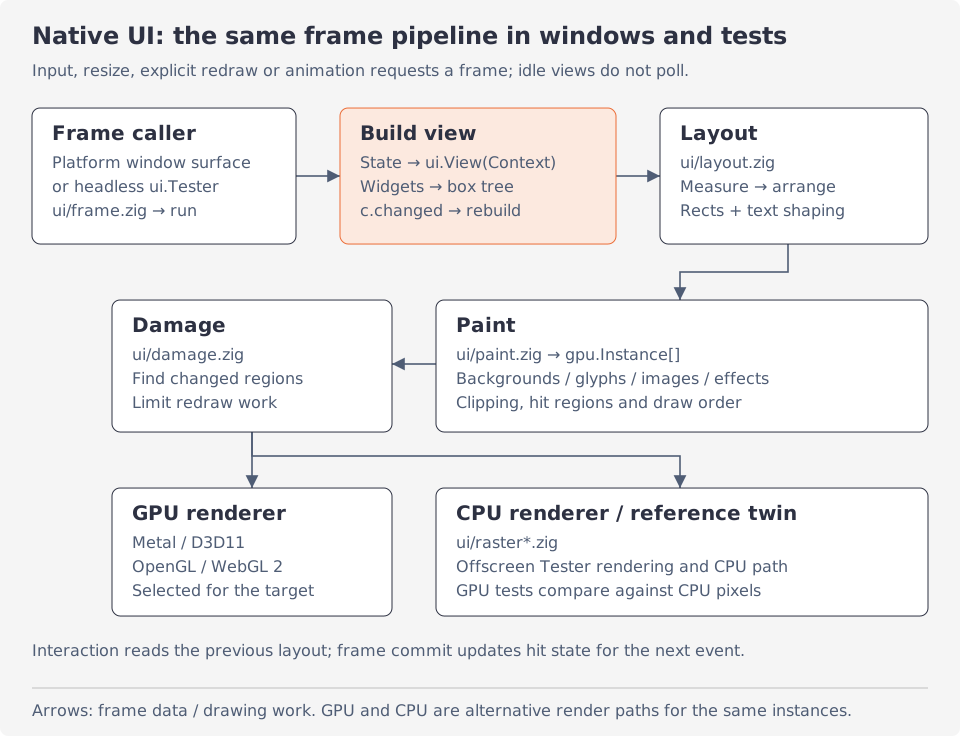
Read the arrows from the frame caller through build, layout and paint, then down to the renderer. gpu.Instance is the shared drawing contract; the CPU path also provides the reference pixels for GPU tests. Text shaping happens during layout and glyph atlases are read during paint.
ui/frame.zig's run makes one frame, and both every window's surface and ui.Tester call it, so what a test sees is what a window shows:
- Build. The view (
ui.View: a pointer and abuildfunction) runs with a*ui.Context. Widgets open and close boxes (Context.open,leaf,end) into a flat tree of nodes for this frame, and answer interactions (clicks, hovers, drags, keys) from the previous frame's layout. A widget whose interaction changed the app's state setsc.changed; the frame is then built again (c.rebuild()), up to four passes, so the screen never lags the state. A box left open panics with how many. - Layout (
ui/layout.zig). Flexbox in two passes:measuresizes boxes from their content bottom up (text is shaped and wrapped here, from cached layouts; each text box's width and wraps are kept by its id across frames, compared, inlayout_cache.zig, and a box measured again at a width in one frame is as it was),arrangeplaces them top down, sharing free room among boxes that grow and taking it from those that shrink as CSS flexbox does (layout_flex.zig), lining up baselines (layout_baseline.zig); absolute boxes, scroll views, grids (grid_layout.zig) and right to left (direction.zig) are handled here. Each node's rectangle is recorded by id for the next frame's interactions. - Paint (
ui/paint.zig). The laid out tree becomes the renderer's instances in paint order: backgrounds, borders, shadows, glyph runs, icons, pictures, gradients, effects and layer marks, each with its clip (rounded clips included), boxes outside their clip culled. Transformed boxes draw their subtree in their own space (paint_xf.zig), and gradients, transforms and effects add rows of data after the instances. Interactive boxes record their visible rectangle (hit.zig), with the inverse map for transformed ones, so the pointer follows what is drawn. A box whose ink (its box grown by its shadow, blur, text and icons reaching out of it, and the ink of the boxes inside it, found from the tree in one pass back to front) its clip leaves out is skipped with all it holds, as Blink and Flutter skip what lies outside the cull rect: a clipped page of a thousand rows paints the rows in view. Transformed boxes and selectable text are painted wherever they are, and nothing is skipped while transitions move boxes or with web views;tests_paint_cull.zigchecks that the instances are those painted without skipping. If an atlas filled up and reset during paint, the frame is painted again. - Commit. What the pointer is over is updated from the new hits; if it changed under a still pointer,
Result.hot_changedasks for another frame.
What the view passes is read in the later phases, after it returns: a text's shaping and wrapping in layout, its glyphs in paint, the accessibility tree after both. So Context.leaf copies a text box's string and spans into the frame's arena (c.alloc(), reset when the next frame begins), and access.describe its strings: freeing them in the view, even between two widgets that show them, cannot leave layout reading freed memory (tests_frame_strings.zig). The copy costs 0.04 to 0.06 ms a frame per thousand text boxes on the hill climb's scenes. Everything else a node points to (a picture's bytes, an icon's name, gradients, canvas paths) must live until the frame is drawn: the app frees such data after the frame (a frame later, or on the next event) or keeps the old copy for one more update.
c.stats (ui.FrameStats) records each phase's milliseconds, the passes, nodes and instances: the inspector and the hill climb read it.
Frames run only when something asks: input, a resize, a change from outside the view (Window.redraw(), on the main thread, for state changed outside the view: a timer, a process's output), or an animation in flight (c.animating, set by Context.animate and motion). Idle, a window draws nothing: tests_idle.zig hovers a button with a tooltip, clicks, toggles, types, leaves a field, turns dark and resizes, and after each checks that the settled window animates nothing, asks for no later frame, and that a frame built anyway would draw nothing. While nothing of a window shows (macOS: occluded, another Space, minimized; Windows: minimized or hidden), frames no input asked for (the display link's or the animation timer's, requests from outside, resizes) wait until some of it shows, as browsers draw nothing for windows out of sight; input still builds one, as keys typed into a key window other windows cover.
Instances
ui/gpu.zig is the contract between paint and every renderer. A frame is an array of gpu.Instance, one quad each:
pub const Instance = extern struct {
    rect: [4]f32,
    color: [4]f32,
    border_color: [4]f32 = .{ 0, 0, 0, 0 },
    uv: [4]f32 = .{ 0, 0, 0, 0 },
    clip: [4]f32 = .{ -1e6, -1e6, 1e6, 1e6 },
    radius: f32 = 0,
    border_width: f32 = 0,
    kind: f32 = 0,
    clip_round: f32 = 0,
};
kind (gpu.Kind) says what the quad is: quad (a rounded rectangle with a border), text (a glyph or icon from the glyph atlas), shadow (a Gaussian blur of a rounded box, as GPUI draws them), image (from the image atlas), effect (a backdrop effect's mark), gradient, layer/layer_end (a blurred or faded group), and trailer. The high bits of kind carry the row of a transform. gpu.Frame.of(instances) splits the instances drawn from the rows of data packed after them, which a final trailer instance points at. A renderer draws a frame in one instanced draw call, splitting it only at effects and layers.
A negative radius asks for continuous corners (Style.corners, raster_corner.zig, after mygo's: Core Animation's curve), and a clip_round made by gpu.clipContinuous (its corners' bits plus 16) for a clip's. Every renderer computes the curve by the same arithmetic (the shaders' cont_* functions): only in a corner's box (extent times the radius from the corner), elsewhere the distance to the nearest side as for square corners, its edge smoothed by the value's gradient by differences a sixteenth of a pixel apart, and a blurred shadow's rows narrowed where the curve is, found by regula falsi. The GPU renderers cut large shadows with continuous corners into nine-patches (gpu_corners.zig, after mygo's 8b35d8e and 3e9f9c6): the bands of rows across the corners as they are at their ends and as their twin with square corners between, and the band between them as the twin, which computes the very same values without the search; a band is cut only where the twin's pixels save more than the pieces (an instance each) cost. The CPU renderer draws them whole; its pixels are the same.
The renderers
| renderer | file and shader | where |
|---|---|---|
| Metal | ui/metal.zig, shader.metal, effects in metal_fx.zig/metal_fx.metal | macOS, into a CAMetalLayer the native view hosts |
| Direct3D 11 | ui/d3d11.zig, d3d11.hlsl (compiled ahead to d3d11.cso), d3d11_fx.* | Windows, into a flip sequential swap chain |
| OpenGL | ui/gl.zig, gl.glsl, gl_fx.*, loaded through gl_api.zig (libepoxy) | Linux, in a GtkGLArea (gl_gtk.zig); OpenGL 3.3 core or ES 3.0 |
| WebGL 2 | ui/webgl.zig, webgl_shaders.zig (gl.glsl as GLSL ES 3.0) | browsers; the context lives in web/host_gl.js |
| CPU | ui/raster.zig, raster_lanes.zig, raster_fill.zig, raster_shadow.zig, raster_xf.zig, raster_fx.zig, raster_pool.zig | everywhere: the fallback, the Tester off macOS, the reference |
Each GPU renderer uses one pipeline: it uploads the frame's instances, the rows of the atlases that changed since it last did (dirty), and draws the instances in one call. Metal and Direct3D 11 take pictures straight into their texture, with no copy of the image atlas in memory. Effects and blurred layers need what was drawn so far: at an effect mark the renderer reads the pixels around the shape, blurs them (backdrop.zig: averaged down for large blurs, then a Gaussian along rows and columns) and draws the box from them, with the effect's shader or as it is.
d3d11.cso is the HLSL compiled ahead of time with zig run src/ui/d3d11_gen.zig (on Windows, after changing the shader), so windows open without loading the shader compiler; it starts with the source's hash, and a renderer whose embedded hash differs from its source compiles the source at start instead.
Drawing only what changed
A frame that changes little of a window (a caret blinking, a spinner turning, a button under the pointer) draws only the pixels that may differ from the last frame, over the rest kept as it was, after mygo's scene.Differ (ui/damage.zig). Differ compares a frame's instances with the last one's from both ends; the instances that differ damage the pixels they drew and draw now (boundsOf: the CPU renderer's bounds, two pixels more for the GPUs' quads, five under a transform). Instances are compared with the rows they read (a transform's, a gradient's, an effect's) wherever those rows are; pictures count as changed when the image atlas did; a frame of another size, scale or background, or after the glyph atlas was emptied (Atlas.resets), draws whole. Effects and blurred layers read what is under them: an area meets one, it grows by all the effect reads (grow, to a fixed point), so that the effect reads nothing of the last frame, and drawn in part, a frame draws only the effects and layers in its area (Markers). Past half the window, it is drawn whole. Drawn in part, every pixel is the one drawing the frame whole gives, byte for byte: damage_test.zig draws random frames of every kind of instance changing frame after frame both ways, on the CPU and with each GPU renderer. MYZIG_PARTIAL=0 draws every frame whole.
| renderer | the target that keeps the last frame | drawing a part |
|---|---|---|
| CPU | the window's pixels | in up to eight rectangles apart from each other (raster.drawPart), each band clipped to them |
| Direct3D 11 | the swap chain, flip sequential: as a frame is presented with the area it drew as its dirty rectangle (Present1), DXGI fills the rest of the buffer from the frame presented before | scissored, cleared by an opaque quad of the frame's color (damage.clearQuad); a frame that changed nothing is not presented |
| OpenGL | a GtkGLArea's framebuffer, which GTK keeps from render to render but makes anew as it allocates the area (Gpu.invalidate) | the scissor test, which glClear keeps to too |
| WebGL 2 | the canvas, with preserveDrawingBuffer | the scissor test, as OpenGL |
| Metal | the layer's drawables, each holding the frame drawn into it some frames ago: damage.Ages keeps, by the drawable's texture (retained, so that no other takes its address), what changed since | passes that load the drawable, scissored, cleared by the quad; a frame that changed nothing takes no drawable |
On a window of 2560 × 1600 pixels (a page of 108 cards, Intel Iris Xe), a caret blinking takes the CPU renderer 0.15 ms a frame rather than 9.3, a spinner 0.34 rather than 10.4; Direct3D draws them to completion in 0.64 and 0.78 ms rather than 5.6 and 6.0. The hill climb's caret and spinner scenes (900 × 640 at 2x) measure it: on the CPU 0.07 and 0.19 ms rather than 6.7 and 6.8, and with --gpu 0.02 and 0.03 ms of Direct3D's GPU time rather than 2.2.
The passes of effects and blurred layers draw through textures kept from frame to frame by their size (Pool in d3d11_fx.zig, gl_fx.zig, metal_fx.zig), after mygo's effect layers: an effect whose box moves reads through the textures of the frame before rather than new ones (40 frames of a moving effect and layer make 13 textures, not 240), and textures no frame took for 120 frames go.
Falling back to the CPU
A GPU renderer that cannot start never stops a window from showing; the same frames are drawn on the CPU instead:
- Windows: without a Direct3D device or swap chain, GDI shows the CPU renderer's pixels (
windows/surface.zig). - Linux: without OpenGL (no libepoxy, no GL context, or a renderer that fails), a GtkDrawingArea and cairo show them.
MYZIG_GPU=0keeps frames on the CPU;MYZIG_GPU=1uses OpenGL even on Mesa's llvmpipe, which is otherwise skipped as slower than myzig's own CPU renderer. - Browsers: without WebGL 2, a 2D canvas shows them.
The CPU renderer
raster.zig draws the instances shader.metal draws into memory: BGRA, premultiplied, sRGB-encoded values blended as the GPU blends them. A frame is drawn in bands of 64 rows, taken in turn by several cores when the frame is large; every pixel is what drawing it alone gives, so bands may draw in any order. The cores are threads of raster_pool.zig, started when a frame first needs them and then waiting on a futex between frames, as starting threads each frame costs about what drawing a small frame does: a frame is shared from about 2¹⁸ pixels' work a core. The clear leaves the pixels the first instance sets to its fill whatever is under them, when it is an opaque quad nothing clips the corners of, as a window's background (Frame.clearRows, raster_fill.zig), so they are not written twice. Within an instance, what is the same along a row or a column is computed once, solid fills are copied, empty texels are skipped, and raster_lanes.zig computes eight pixels at a time, each fast path giving the exact value of the general one.
The CPU twin
The CPU renderer is the reference every GPU renderer is held to: each shader is written to compute, per pixel, what raster.zig computes, by the same arithmetic (instance bounds rounded the same way, exact distance gradients instead of fwidth, textures filtered by hand from texels with full precision weights). Tests render the same frames both ways and compare them, to a level or two of blending's rounding:
| test | compares |
|---|---|
ui/tests_raster.zig | the CPU renderer against Metal (macOS): widgets, text, icons, borders, rounded corners and clips, shadows, a picture |
ui/d3d11_test.zig | Direct3D 11 offscreen (a texture read back) against the CPU; skipped without a GPU |
ui/gl_test.zig | OpenGL 3.3 and ES 3.0 offscreen (EGL without a surface, gl_offscreen.zig; Mesa's llvmpipe needs no GPU) against the CPU |
ui/gl_gtk_test.zig | the GtkGLArea path |
ui/gpu_fx_test.zig | every GPU renderer against the CPU on the general path: random transforms of every kind, gradients, backdrop effects plain and with a shader, blurred layers, in widget frames and random frames |
ui/shader/tests_gpu.zig | shaders of ui.shader on each GPU against their CPU twin |
ui/damage_test.zig | frames drawn in part against them drawn whole, byte for byte: the CPU, Direct3D 11 (a texture, and a hidden window's swap chain), OpenGL 3.3 and ES 3.0 |
ui.gpu_testing exports gpu_fx_test.zig so plugins hold their own effects to the same standard (the glass plugin's shader has a CPU twin that must draw the same pixels).
Shaders apps write (ui.shader, files like examples/*/*.zsl) follow the same rule: a small language in Zig's syntax (ui/shader/parse.zig) is compiled at compile time into HLSL, GLSL (3.3, ES 3.0, WebGL 2), Metal, and a CPU twin of Zig code (shader/cpu.zig) that the CPU renderer and the Tester run. See shaders.
Canvases (ui.canvas) and SVG pictures are rasterized on the CPU (canvas_render.zig, path_raster.zig: an accumulation rasterizer after font-rs, with both fill rules) into the image atlas, which every renderer then draws as it draws ui.image, so they look the same everywhere by construction.
Text
ui/text.zig picks the text system at compile time:
- CoreText on macOS (
text_mac.zig,atlas.zig): fonts, shaping and glyph rasterization by the system, into an R8 atlas texture. Printable ASCII takes an exact fast path (shaper.zig), tested against CoreText's own shaping. - myzig's TrueType everywhere else, and on macOS with
-Dportable=true(text_tt.zig,ui/tt/):tt/fontdb.zigfinds the installed fonts once (by family, weight, italics and width, loaded on first use, with fallback families and then any face for missing characters),tt/font.zigreads the font files,tt/raster.zigturns outlines into coverage, andatlas_tt.zigkeeps the glyphs in a byte-per-texel image in memory, which the CPU renderer samples and GPU renderers upload. Icons are line icons drawn by myzig (icons.zig) instead of SF Symbols. In browsers the fonts come with the site (browsers).
Both give the same interface: fonts, shaped and wrapped layouts cached across frames, carets, and the glyph atlas. Glyphs are rasterized once per font and quarter pixel of horizontal position, at the display's scale, shelf packed; an atlas grows when full, then resets (and the frame is painted again).
Pictures (ui.image) are decoded once (ImageIO on macOS, png_decode.zig elsewhere), scaled to at most the atlas's side, and packed into one BGRA atlas (images.zig), emptied and packed again when full.
Surfaces
A surface connects a window to its native UI: it turns the platform's events into ui.Input, runs frames on demand, and presents them.
| platform | surface | presents | paces frames with |
|---|---|---|---|
| macOS | ui/surface.zig: an NSView hosting the Metal layer, NSTextInputClient (textinput.zig) | Metal | the view's display link, while something animates; skipped while the window is occluded |
| Linux | linux/surface.zig | GtkGLArea (OpenGL), else GtkDrawingArea and cairo | GTK's frame clock (a tick callback) |
| Windows | windows/surface.zig | Direct3D 11 swap chain, else GDI | a 60 Hz timer while something animates; WM_FRAME for requests from outside; the swap chain's frame latency object (surface_present.zig) |
| Browsers | web/surface.zig | WebGL 2, else a 2D canvas | requestAnimationFrame, asked once per frame needed |
All of them draw at the monitor's scale (Retina, per-monitor DPI, the device pixel ratio) and feed input methods' text to the focused field.
On Windows one frame waits ahead of the screen, and Present never blocks the main thread for it, after mygo's: the swap chain has a frame latency object (FRAME_LATENCY_WAITABLE_OBJECT, SetMaximumFrameLatency(1) on IDXGISwapChain2), which DXGI signals as the screen takes a frame. A frame presents once a wait on it succeeded, the wait's token; a frame drawn while it is not signaled waits (pending) as a thread waits on the object and posts WM_PRESENT, when it presents. The animation timer's frames are not built meanwhile; frames for input draw into the frame waiting (it presents as the union of their dirty areas). A resize's frame presents at once. Every present takes one token, so the object's count stays that of the frames the screen can take.
On macOS the main thread never blocks in -[CAMetalLayer nextDrawable], after mygo's: that call waits while the layer's drawables are all in use, which the display holds until its next refreshes, so a frame following another would wait most of a refresh with input queued behind it. After each frame presented as soon as drawn, a serial dispatch queue at the main thread's priority (user interactive) fetches the next frame's drawable into a one-slot mailbox (ui/metal_present.zig) and posts its completion to the main queue. A frame for input that comes meanwhile is built at once (input handled, laid out, painted) and its drawing waits; once the drawable came, the main thread draws the surface's instances as they are then (wake, the surface's drawableCame), a frame like the last one drawing nothing. The display link's ticks build no frame while a fetch is in flight (Renderer.ready): the next is built once the drawable came, with the link ticking meanwhile. Threads share one thing: the queue writes the mailbox's drawable, then posts the completion; the main thread reads it only in that completion or after settle, which waits for the queue (dispatch_sync_f), both of which order the write before the read. Everything else (in flight, wanted, the completions' counts) is the main thread's. Before the layer changes (its drawables' size, their format, presenting with the transaction, the renderer freed) the main thread settles the fetch and lets the drawable go; a frame presented with the transaction (a live resize's) takes its own on the main thread, as the first frame does. A presenter freed with completions posted frees itself when the last one runs, so none reaches freed memory; a fetch whose completion comes after settle is counted stale and does not end the next. The protocol is tested with a fake layer and queue (ui/metal_present_test.zig).
Input latency, from an event's arrival to the frame showing it on the screen, is measured by tools/inputlatency (its README), after mygo's: typing, scrolling, dragging and animations in a window it shows, split into waiting for the main thread, handling, reaching the present, and reaching the screen, with the main thread's waits for drawables and the share of refreshes showing a new frame. It synthesizes input into its own window, so a person runs it; agents build and test it.
Accessibility is a separate tree built from the frame (ui/access_tree.zig) and served per platform: NSAccessibility (access_mac.zig), AT-SPI over D-Bus (linux/atspi*.zig), UI Automation (windows/uia*.zig). See accessibility.