
IPC and TypeScript generation
How a page and the Zig app talk: the page runtime, the wire protocol, the outbox, events, channels, evaluation, trust, the app's schemes, and the client generated from Zig types. For how apps use them, see bindings and pages; for the rest of the architecture, the overview.
The pieces
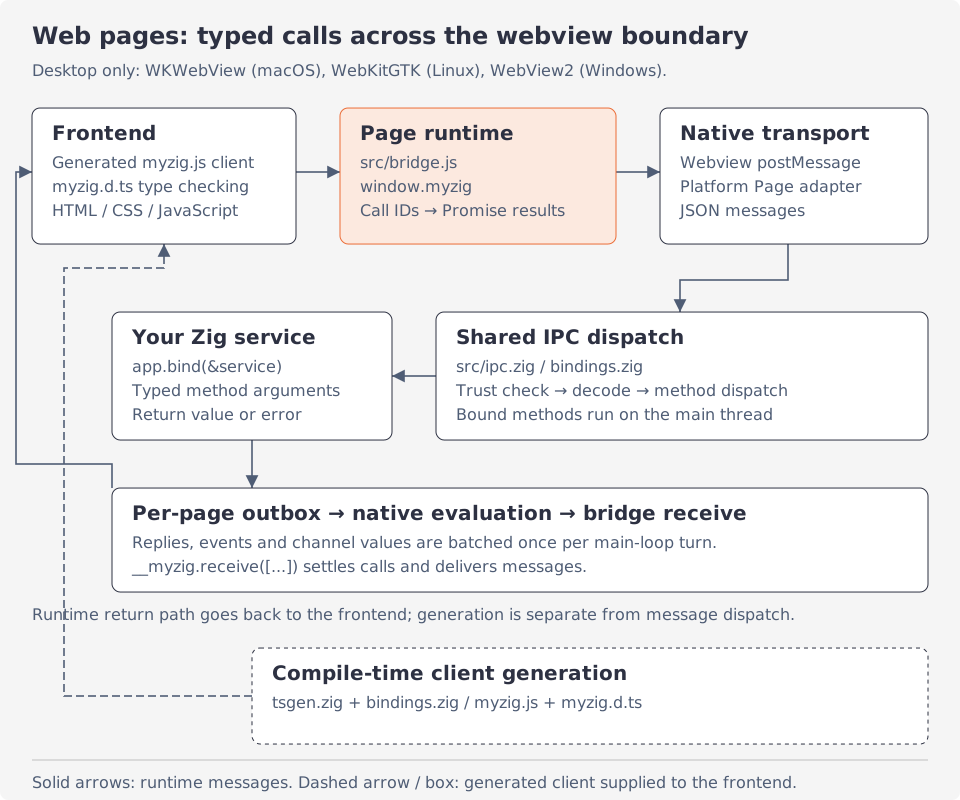
Follow the solid arrows for a runtime call and its reply. The dashed generation path happens at compile time: Zig service types produce the JavaScript client and TypeScript declarations used by the frontend. Events and channel values share the outbox return path.
| file | what |
|---|---|
src/bridge.js | the page runtime, window.myzig, injected into every document's main frame |
src/ipc.zig | Call, Event, bound services' dispatch, handleMessage (every message from a page) |
src/bindings.zig | the app's bound services and registered events and channel kinds; the generated client |
src/channel.zig | myzig.Channel(T) and myzig.ChannelKind(name, T) |
src/page_channel.zig | one page's channels: ids, sequence numbers, flow control |
src/page_core.zig | what every page shares: dev server, trust, evaluations, user scripts, page events |
src/page_serve.zig | what the app's schemes serve (myzig:// and PageOptions.schemes) |
src/page_find.zig | find in page, through the bridge |
src/tsgen.zig | comptime TypeScript declarations and the JavaScript client |
page.zig, linux/page.zig, windows/page.zig | each platform's web view: injecting the bridge, posting, the outbox, schemes |
The protocol is the same on every platform; only the transport differs:
| page → Zig | Zig → page | app scheme | |
|---|---|---|---|
| macOS | webkit.messageHandlers.myzig.postMessage | evaluateJavaScript: | myzig://localhost/ (WKURLSchemeHandler) |
| Linux | webkit.messageHandlers.myzig.postMessage | webkit_web_view_run_javascript | myzig://localhost/ (registered on the web context) |
| Windows | chrome.webview.postMessage | ExecuteScript | http://myzig.localhost/ (WebResourceRequested) |
WebView2 cannot register custom schemes the way WebKit does, so an app scheme <s> is served at http://<s>.localhost/ there (page_core.scheme_hosts), and its requests are turned back into SchemeRequests of <s>://localhost/ before the app sees them.
The page runtime
bridge.js runs at document start in the main frame (a WKUserScript, WebKitGTK's user content manager, WebView2's AddScriptToExecuteOnDocumentCreated), before the page's own scripts, and defines two frozen globals:
window.myzig:call,on,once,onChannel,Channel,log,window(close,minimize,toggleMaximize,setTitle),platform("macos","linux"or"windows") andversion.window.__myzig:receive,settle,find,stopFind, which only Zig calls.
It also posts dom-ready when the DOM is loaded, and turns a left mouse down in an element styled --app-region: drag into a drag message (or dblclick for a double click), so frameless windows move from the page; --app-region: no-drag stops the search up the tree.
Wire protocol
Every message is one JSON object with a type t. The page posts each one as a string. Zig answers in batches: messages wait in the page's outbox, and once per turn of the main loop the outbox is flushed as one script, __myzig.receive([m1, m2, ...]).
Page → Zig:
| message | meaning |
|---|---|
{"t":"call","id":N,"m":"Service.method","a":[...]} | call a bound method with JSON arguments |
{"t":"eval","id":N,"k":TOKEN,"ok":true,"v":"JSON"} | the result of an evaluation (ok:false,"e":... for its error) |
{"t":"chan-msg","c":ID,"v":"JSON","n":SEQ[,"a":1]} | a channel value (a: acknowledge it) |
{"t":"chan-ack","c":ID,"n":SEQ} | the page took Zig's values up to SEQ |
{"t":"chan-close","c":ID} | the page closed a channel |
{"t":"dom-ready"} | the document's DOM is ready |
{"t":"log","v":"..."} | myzig.log(...): printed as page: ... on stderr |
{"t":"drag"}, {"t":"dblclick"} | a drag region was pressed (move, or zoom the window) |
{"t":"win","op":"close"|"minimize"|"zoom"|"title","v":...} | myzig.window.* |
Zig → page:
| message | meaning |
|---|---|
{"t":"reply","id":N,"ok":true,"v":VALUE} | a call's result |
{"t":"reply","id":N,"ok":false,"e":"Service.method: ErrorName"} | a call's error |
{"t":"event","n":NAME,"p":PAYLOAD} | a typed event |
{"t":"chan","c":ID,"p":VALUE[,"a":1]} | a channel value (a: acknowledge it) |
{"t":"chan","c":ID,"end":true} | Zig closed the channel |
{"t":"chan-open","c":ID,"n":NAME} | Zig opened a channel of kind NAME (ids below 0) |
{"t":"chan-ack","c":ID,"n":SEQ} | Zig took the page's values up to SEQ |
Calls
ipc.handleMessage runs on the main thread for every message. A call:
- is parsed into an envelope in an arena freed when the reply is sent;
- is refused with
Untrustedunless the page's current URL is trusted (below); - finds the service by the part before the dot (
UnknownService) and dispatches the method by name; dispatch is aninline forover the service's methods generated at compile time (UnknownMethod); - decodes each argument with
std.json.parseFromValueLeakyinto the parameter's Zig type, ignoring unknown fields (InvalidArgument,MissingArgument,TooManyArguments). A*myzig.Callparameter is filled by myzig (the call'sarenaand itswindow) and takes no argument; amyzig.Channel(T)parameter takes the id of a channel the page made; - calls the method, unwraps an error union, and writes the result with
std.json.Stringify(voidisnull).
An error becomes "ok":false with "Service.method: ErrorName", which rejects the page's promise with an Error of that message. If the method closed its own window, no reply is sent: the page is gone. Call and evaluation IDs must be nonnegative JavaScript safe integers; messages with missing or invalid IDs are ignored.
The outbox
Page.enqueue(msg, hold) appends a message to the outbox and schedules one flush if none is scheduled: objc.dispatchMain on macOS, g_idle_add on Linux, a posted WM_FLUSH on Windows. However many replies, events and channel values a turn of the loop produces, the page runs one script.
Events and channel values are sent with hold = true: until the document posts dom-ready, they wait in a list of held messages (up to 1024), moved to the outbox when it does, so a page never misses an event sent while it loads. A navigation (Page.navigated) drops what is held, fails the evaluations under way, and closes the old document's channels with the reason lost.
Events
myzig.Event("tick", T) is a type with name, Payload and its generated client. emit(window, payload) encodes {"t":"event","n":"tick","p":...} on the calling thread and hands it to the window's thread (Window.sendOwned), so it is safe from any thread; broadcast(app, payload) enqueues it for every window with a page, on the main thread. The page's myzig.on("tick", fn) (or the generated onTick(fn)) gets the payload.
Channels
Channels are ordered streams of typed values both ways, until either side closes them. A page makes one with new Channel() and passes it to a bound method taking myzig.Channel(T) (ids above 0); Zig opens one with myzig.ChannelKind("logs", T).open(window) (ids below 0), which the page hears of through myzig.onChannel("logs", fn) or the generated onLogsChannel(fn). Retained Zig channels report closed after their window closes. The app must outlive its channels. An onClose listener may close its window or navigate: the old channel's end message is not sent to a page that disappeared or a new document.
Flow control is a window of bytes (page_channel.window_bytes, 1 MiB) on each side. Values from Zig wait in the page until it takes them (an onmessage handler, or for await). Every half window the sender asks for an acknowledgment ("a":1); the receiver answers with chan-ack of the sequence number once it has taken that value. While more than a window is unacknowledged:
- in Zig,
Channel.sendfails witherror.ChannelFull, and the channel'sonDrainlistener runs when the page took enough; - in the page,
channel.send(v)returns a promise that resolves once Zig has room again.
A channel closes with a CloseReason: zig, page, or lost (the page navigated or closed). Channel.onClose hears it; values sent after are refused with error.ChannelClosed.
Evaluation
Page.eval(js) runs a script without waiting. Page.evalResult(js, cb) wraps the expression as
window.__myzig&&__myzig.settle(ID,"TOKEN",async()=>(
  <expression>
))
The bridge awaits it and posts {"t":"eval","id":ID,"k":TOKEN,...}. The token is 8 random bytes per page (16 hex digits), so a page's own scripts cannot forge a result. A navigation or closing fails what is pending ("the page navigated", "the page closed"). Values that cannot be encoded as JSON, such as a BigInt or an object with circular references, report an evaluation error too.
Trust
Only a trusted document may call bound services, open channels and get permissions. page_core.trusted trusts:
about:,file:andblob:URLs of a trusted origin;- the app's schemes (
myzigand those ofPageOptions.schemes, and on Windows theirhttp://<scheme>.localhosthosts); - the dev server's origin (
MYZIG_DEV_URL, elsePageOptions.dev_url); - the origins in
PageOptions.trusted_origins("*"trusts any).
Trust is checked against the page's current URL at each call, so a page that navigates elsewhere loses it. Origins are compared in full, including long authorities; fixed-size header buffers never determine whether an origin is trusted. Messages from subframes are refused before dispatching IPC: macOS checks the frame, WebView2 delivers only the top frame's, and on Linux the bridge's messages carry the page's token, which subframes never see.
The app's schemes
page_serve.dispatch answers every request of an app scheme, the same way on every platform:
- A trusted page of another origin gets CORS headers (
Access-Control-Allow-Originits origin;OPTIONSanswered204). - A scheme of
PageOptions.schemesgoes to its handler, which answers theSchemeRequestnow or later (req.respond(status, headers, body)). myzig://serves the frontend:/myzig.jsis the generated client (App.clientJs); then the file ofassets_dir(MYZIG_ASSETS_DIRoverrides it; paths are percent-decoded once, then paths with.., backslashes, drives or NUL bytes are refused), then the embeddedassets; a path without an extension that is no file is a client-side route and gets/index.html.- Anything else is
404 Not Found.
Responses carry Cache-Control: no-cache, so a rebuilt frontend shows on reload.
TypeScript generation (tsgen.zig)
Zig keeps types at compile time, so the client is generated by the compiler: App.bind(&service) stores, with the service's dispatch, its tsgen.service(T), and App.registerEvent(E) stores E.client (an event's or a channel kind's). Nothing is generated at run time but the concatenation.
What a service exposes: its public functions whose first parameter is the service (T, *T or *const T), not generic, not starting with _. Its name in the client is T.myzig_name, else the last part of @typeName(T). Zig keeps no parameter names in function types, so a service names them:
pub const myzig_params = .{ .greet = .{"name"} };(unnamed parameters are arg0, arg1, ...). *myzig.Call parameters are left out of the client.
Types map as follows:
| Zig | TypeScript |
|---|---|
void | void |
bool | boolean |
| integers, floats | number |
[]const u8, [N]u8 | string |
[]T, [N]T | T[] ((A | B)[] when needed) |
?T | T | null; an optional struct field is also field?: |
E!T | T (errors reject the promise) |
enum { a, b } | export type E = "a" | "b"; |
struct {...} | export interface S {...}, deduplicated by name; recursive types terminate |
std.json.Value | unknown |
myzig.Channel(T) | Channel<T> |
Tuples and other types are a compile error naming the type.
The output:
myzig.d.ts(Bindings.clientDts):runtime_dts(theChannel<T>interface andmyzig's declaration), then the declarations of every type, every service asexport declare const Greeter: { greet(name: string): Promise<string>; }, every event asonTick(listener), every channel kind asonLogsChannel(listener).myzig.js(Bindings.clientJs): re-exportsmyzigandChannel, then each service as a frozen object of methods callingwindow.myzig.call("Greeter.greet", ...a), and each event as(fn) => window.myzig.on("tick", fn). It is served at/myzig.jsand built once per app.
Event names become PascalCase after on (build-logs gives onBuildLogsChannel). Services are sorted, so the output is stable.
--myzig-generate=DIR makes App.run write both files into DIR and exit (zig build gen does it for the hello example, myzig generate for an app). Every new type mapping gets a test in tsgen.zig.
Plugins with a page side ship their own JavaScript as an Asset (for example the fetch plugin's fetch.asset at /plugins/fetch.js), which calls their bound service through window.myzig.